


Environment Sustainability Management is an integral part of business strategy at Delhi Airport, which helps in achieving credibility and business sustainability. DIAL is committed to conduct its business in an environment-friendly and sustainable manner by minimizing the impact of its activities on the environment with necessary pollution control systems and safeguards.
We at IGIA embrace the concept of sustainability by managing environmental needs effectively, by minimizing resource utilization, by adopting green infrastructures and by improving operational excellence.
DIAL’s Green Finance Framework in line with Green Bond Principles and Green Loan Principles of ICMA and LMA respectively.
SPO of DIAL’s Green Finance Framework by CICERO Shades of Green.
Assessment Report on Green Bond Initiatives.
Green Bond Allocation Certificate.
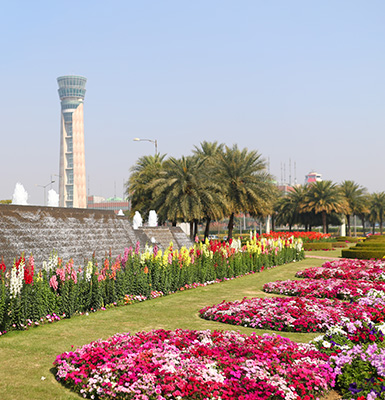 DIAL has adopted Environment Management System (EMS) at Delhi Airport and is certified under ISO 14001:2015. EMS provides an organized and formal approach towards managing environmental aspects and its impacts at IGI Airport.
 Aircraft Noise abatement is one of the key areas the DIAL focuses on. In order to manage aircraft noise, DIAL along with stakeholders such as Director General of Civil Aviation (DGCA), Air Traffic Controller (ATC), Airport Authority of India (AAI) and Central Pollution Control Board (CPCB) have implemented various noise mitigation measures. Further, ICAO balanced approach is followed to reduce the noise impact.
 Air quality management & Emission reduction are focused areas at Delhi Airport; DIAL being an environmentally responsible organization has taken numerous initiatives to improve the overall air quality aspects in Delhi Airport. Some of the key initiatives adopted by Delhi Airport are.
 Water is one of the key elements required for the efficient, hygienic and customer friendly airport operation, thus water management is one of the major focus areas at Delhi Airport. DIAL’s key objectives are-Sustainable development and management of water resources by continual assessment, conservation, augmentation, protection from pollution and safe distribution.
 Cleanliness & waste management is extremely important at DIAL for ensuring hygiene, achieving high service quality standard and safety measure against bird strikes. Delhi Airport works exclusively with waste management companies which employ the highest environmental standards to handle different kind of waste streams. DIAL’s objective is to ensure effective waste management system for collection, segregation, storage and safe disposal of waste and comply with all regulatory requirements.
 Extensive flora and fauna studies have been undertaken to determine the biodiversity values that exist within the airport boundary. The findings have been further supplemented through additional studies that are being undertaken as part of the Environmental Impact Assessment (EIA). Animals are rehabilitated with the help of wildlife and forest department and NGOs to various Wildlife Sanctuaries of Delhi.
 Climate change is currently the biggest environmental challenge to humanity. DIAL being a responsible organization has taken up various mitigation and adaptation measures to reduce the impacts of climate change.
 DIAL is highly focused towards ensuring sustainable development at Delhi Airport. The sustainability focus and strategies have yielded Terminal 3 being the first LEED Gold Accredited airport terminal building in the world for its green footprint for New Construction and IGBC Platinum rated for Existing Building standard.


Secured by